Entity Relationship Overview
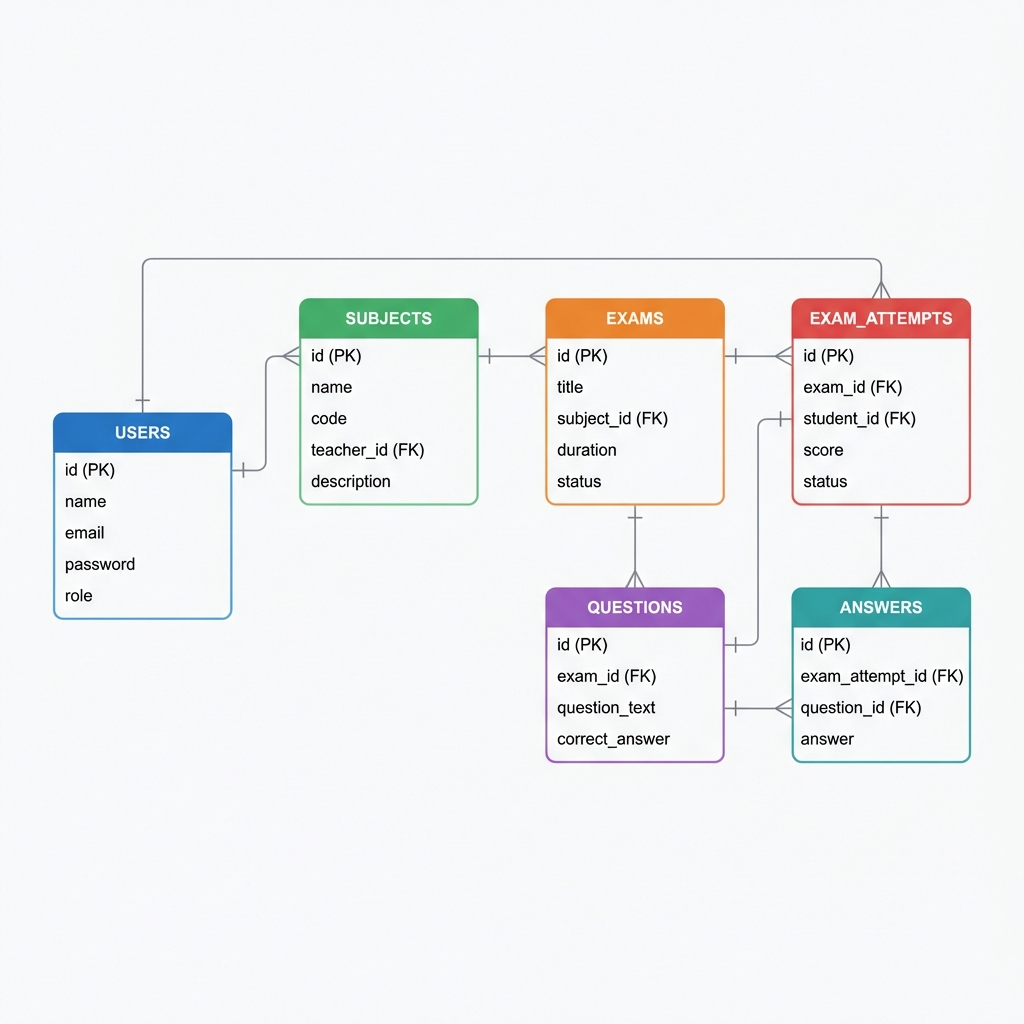
Before writing any code, let's understand our data model:
Entity Relationship Diagram
Tables Overview
| Table | Description | Key Relationships |
|---|---|---|
| users | All users (Admin, Teacher, Student) | Has roles via Spatie |
| subjects | Course subjects (Math, Physics, etc.) | Belongs to Teacher |
| exams | Individual exams/tests | Belongs to Subject, has many Questions |
| questions | Exam questions | Belongs to Exam |
| exam_attempts | Student's exam session | Belongs to Exam and Student |
| answers | Student's answers | Belongs to ExamAttempt and Question |
Laravel Eloquent Relationships
| Model | Relationship | Related Model |
|---|---|---|
| User (Teacher) | hasMany | Subject |
| Subject | belongsTo | User |
| Subject | hasMany | Exam |
| Exam | belongsTo | Subject |
| Exam | hasMany | Question |
| Exam | hasMany | ExamAttempt |
| Question | belongsTo | Exam |
| ExamAttempt | belongsTo | User (Student) |
| ExamAttempt | belongsTo | Exam |
| ExamAttempt | hasMany | Answer |
| Answer | belongsTo | ExamAttempt |
| Answer | belongsTo | Question |
Step 1: Create Migrations
Subjects Table
BASH
php artisan make:migration create_subjects_table
PHP
<?php

use Illuminate\Database\Migrations\Migration;
use Illuminate\Database\Schema\Blueprint;
use Illuminate\Support\Facades\Schema;

return new class extends Migration
{
    public function up(): void
    {
        Schema::create('subjects', function (Blueprint $table) {
            $table->id();
            $table->string('name');
            $table->string('code')->unique();
            $table->text('description')->nullable();
            $table->foreignId('teacher_id')->constrained('users')->onDelete('cascade');
            $table->boolean('is_active')->default(true);
            $table->timestamps();
        });
    }

    public function down(): void
    {
        Schema::dropIfExists('subjects');
    }
};
Exams Table
BASH
php artisan make:migration create_exams_table
PHP
<?php

use Illuminate\Database\Migrations\Migration;
use Illuminate\Database\Schema\Blueprint;
use Illuminate\Support\Facades\Schema;

return new class extends Migration
{
    public function up(): void
    {
        Schema::create('exams', function (Blueprint $table) {
            $table->id();
            $table->string('title');
            $table->text('description')->nullable();
            $table->foreignId('subject_id')->constrained()->onDelete('cascade');
            $table->integer('duration_minutes')->default(60);
            $table->integer('passing_score')->default(60);
            $table->integer('total_questions')->default(0);
            $table->dateTime('start_time');
            $table->dateTime('end_time');
            $table->enum('status', ['draft', 'published', 'closed'])->default('draft');
            $table->boolean('shuffle_questions')->default(false);
            $table->boolean('show_result')->default(true);
            $table->timestamps();
        });
    }

    public function down(): void
    {
        Schema::dropIfExists('exams');
    }
};
Questions Table
BASH
php artisan make:migration create_questions_table
PHP
<?php

use Illuminate\Database\Migrations\Migration;
use Illuminate\Database\Schema\Blueprint;
use Illuminate\Support\Facades\Schema;

return new class extends Migration
{
    public function up(): void
    {
        Schema::create('questions', function (Blueprint $table) {
            $table->id();
            $table->foreignId('exam_id')->constrained()->onDelete('cascade');
            $table->text('question_text');
            $table->enum('question_type', ['multiple_choice', 'true_false', 'essay'])->default('multiple_choice');
            $table->json('options')->nullable(); // For multiple choice
            $table->string('correct_answer');
            $table->integer('points')->default(1);
            $table->integer('order')->default(0);
            $table->timestamps();
        });
    }

    public function down(): void
    {
        Schema::dropIfExists('questions');
    }
};
Exam Attempts Table
BASH
php artisan make:migration create_exam_attempts_table
PHP
<?php

use Illuminate\Database\Migrations\Migration;
use Illuminate\Database\Schema\Blueprint;
use Illuminate\Support\Facades\Schema;

return new class extends Migration
{
    public function up(): void
    {
        Schema::create('exam_attempts', function (Blueprint $table) {
            $table->id();
            $table->foreignId('exam_id')->constrained()->onDelete('cascade');
            $table->foreignId('student_id')->constrained('users')->onDelete('cascade');
            $table->dateTime('started_at');
            $table->dateTime('completed_at')->nullable();
            $table->integer('score')->nullable();
            $table->integer('correct_answers')->default(0);
            $table->integer('total_answered')->default(0);
            $table->enum('status', ['in_progress', 'completed', 'timed_out'])->default('in_progress');
            $table->timestamps();

            $table->unique(['exam_id', 'student_id']);
        });
    }

    public function down(): void
    {
        Schema::dropIfExists('exam_attempts');
    }
};
Answers Table
BASH
php artisan make:migration create_answers_table
PHP
<?php

use Illuminate\Database\Migrations\Migration;
use Illuminate\Database\Schema\Blueprint;
use Illuminate\Support\Facades\Schema;

return new class extends Migration
{
    public function up(): void
    {
        Schema::create('answers', function (Blueprint $table) {
            $table->id();
            $table->foreignId('exam_attempt_id')->constrained()->onDelete('cascade');
            $table->foreignId('question_id')->constrained()->onDelete('cascade');
            $table->text('answer')->nullable();
            $table->boolean('is_correct')->nullable();
            $table->integer('points_earned')->default(0);
            $table->timestamps();

            $table->unique(['exam_attempt_id', 'question_id']);
        });
    }

    public function down(): void
    {
        Schema::dropIfExists('answers');
    }
};
Step 2: Create Models
Subject Model
BASH
php artisan make:model Subject
PHP
<?php

namespace App\Models;

use Illuminate\Database\Eloquent\Factories\HasFactory;
use Illuminate\Database\Eloquent\Model;
use Illuminate\Database\Eloquent\Relations\BelongsTo;
use Illuminate\Database\Eloquent\Relations\HasMany;

class Subject extends Model
{
    use HasFactory;

    protected $fillable = [
        'name',
        'code',
        'description',
        'teacher_id',
        'is_active',
    ];

    protected $casts = [
        'is_active' => 'boolean',
    ];

    public function teacher(): BelongsTo
    {
        return $this->belongsTo(User::class, 'teacher_id');
    }

    public function exams(): HasMany
    {
        return $this->hasMany(Exam::class);
    }
}
Exam Model
PHP
<?php

namespace App\Models;

use Illuminate\Database\Eloquent\Factories\HasFactory;
use Illuminate\Database\Eloquent\Model;
use Illuminate\Database\Eloquent\Relations\BelongsTo;
use Illuminate\Database\Eloquent\Relations\HasMany;

class Exam extends Model
{
    use HasFactory;

    protected $fillable = [
        'title',
        'description',
        'subject_id',
        'duration_minutes',
        'passing_score',
        'total_questions',
        'start_time',
        'end_time',
        'status',
        'shuffle_questions',
        'show_result',
    ];

    protected $casts = [
        'start_time' => 'datetime',
        'end_time' => 'datetime',
        'shuffle_questions' => 'boolean',
        'show_result' => 'boolean',
    ];

    public function subject(): BelongsTo
    {
        return $this->belongsTo(Subject::class);
    }

    public function questions(): HasMany
    {
        return $this->hasMany(Question::class);
    }

    public function attempts(): HasMany
    {
        return $this->hasMany(ExamAttempt::class);
    }

    public function isActive(): bool
    {
        $now = now();
        return $this->status === 'published'
            && $now->between($this->start_time, $this->end_time);
    }
}
Question Model
PHP
<?php

namespace App\Models;

use Illuminate\Database\Eloquent\Factories\HasFactory;
use Illuminate\Database\Eloquent\Model;
use Illuminate\Database\Eloquent\Relations\BelongsTo;

class Question extends Model
{
    use HasFactory;

    protected $fillable = [
        'exam_id',
        'question_text',
        'question_type',
        'options',
        'correct_answer',
        'points',
        'order',
    ];

    protected $casts = [
        'options' => 'array',
    ];

    public function exam(): BelongsTo
    {
        return $this->belongsTo(Exam::class);
    }
}
Step 3: Run Migrations
BASH
php artisan migrate
Step 4: Create Seeders
BASH
php artisan make:seeder SubjectSeeder
PHP
<?php

namespace Database\Seeders;

use App\Models\Subject;
use App\Models\User;
use Illuminate\Database\Seeder;

class SubjectSeeder extends Seeder
{
    public function run(): void
    {
        $teacher = User::first();

        $subjects = [
            ['name' => 'Mathematics', 'code' => 'MATH101'],
            ['name' => 'Physics', 'code' => 'PHYS101'],
            ['name' => 'English', 'code' => 'ENG101'],
            ['name' => 'Computer Science', 'code' => 'CS101'],
        ];

        foreach ($subjects as $subject) {
            Subject::create([
                ...$subject,
                'teacher_id' => $teacher->id,
            ]);
        }
    }
}
Summary
We've designed a complete database schema with:
- ✅ Subjects managed by teachers
- ✅ Exams with configurable settings
- ✅ Questions with multiple types
- ✅ Student exam attempts and answers
- ✅ Proper relationships and constraints
What's Next
In Part 4, we'll implement authentication and user roles:
- Role-based access (Admin, Teacher, Student)
- Separate Filament panels for different roles
- Permission management with Spatie
Continue to Part 4: Authentication & User Roles →